In 2025, i-Ready Diagnostic continues to be one of the most widely used tools for assessing student performance in reading and math across K-12 schools. The assessment gives valuable insights into a student’s strengths and areas of improvement, helping teachers design personalized learning paths. With the 2025 updates, educators and parents may notice some important changes in scoring, interpretation, and expectations. In this post, we will explain everything you need to know about iready diagnostic scores 2025.
What is i-Ready Diagnostic?
i-Ready Diagnostic is an adaptive assessment that evaluates students’ proficiency in reading and math. As students answer questions, the test adjusts its difficulty based on their responses, providing an accurate picture of their skill level. The goal is not to give a “grade” but to pinpoint where students are in their learning journey.
In 2025, i-Ready continues to focus on three main objectives:
- Identify each student’s current skill level.
- Measure growth over time.
- Provide tailored learning recommendations.
Schools typically administer the i-Ready Diagnostic three times per year — Fall, Winter, and Spring — to monitor progress and adjust instruction accordingly.
i-Ready Diagnostic Scores 2025 Explained
Scale Scores
In the 2025 version, students will continue to receive scale scores, which are numerical values representing their performance level. These scores are consistent across grade levels, meaning a 450 in Grade 4 is equivalent to a 450 in Grade 6. This allows teachers and parents to monitor true growth, not just performance relative to grade expectations.
The i-Ready scale score ranges vary depending on the subject:
- Reading scale scores typically range from 100 to 800.
- Math scale scores typically range from 100 to 800.
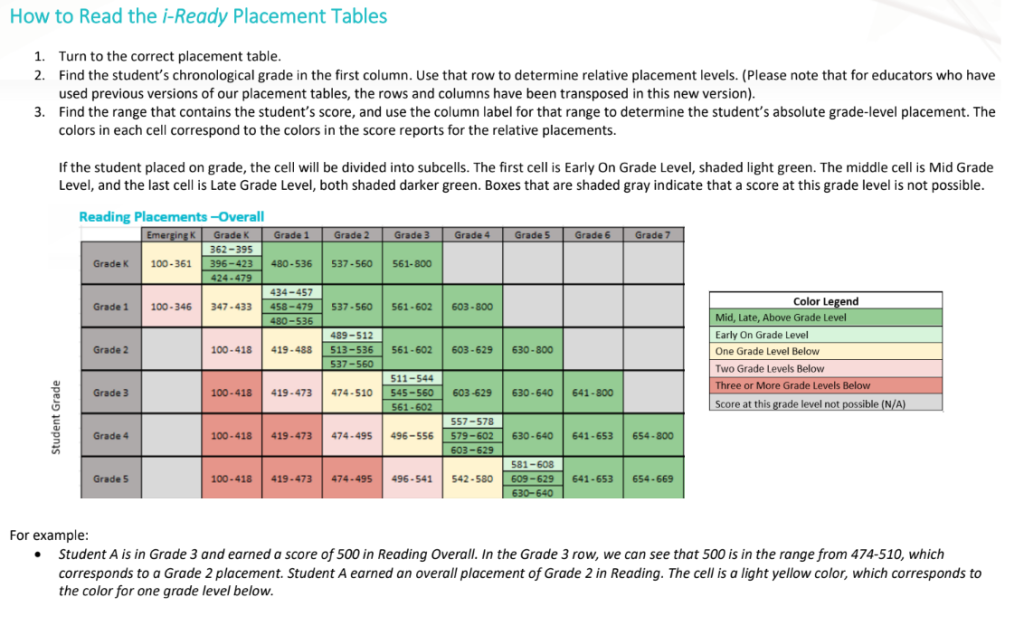
Placement Levels
Along with the scale score, students will be categorized into placement levels:
- Below Grade Level
- Approaching Grade Level
- On Grade Level
- Above Grade Level
In 2025, i-Ready has fine-tuned these categories to better align with updated curriculum standards. For example, the thresholds for “On Grade Level” may have shifted slightly to reflect changes in state and national benchmarks.
Growth Measures
One of the most important components is the Typical Growth and Stretch Growth targets.
- Typical Growth is the expected amount of improvement a student should make within one school year.
- Stretch Growth is a more ambitious target that, if achieved, could help students close achievement gaps.
In 2025, i-Ready has introduced more personalized growth targets based on historical data, ensuring goals are both challenging and attainable for students.
How to Interpret i-Ready Diagnostic Scores
For Teachers
Teachers use i-Ready scores to group students for differentiated instruction, identify students who need additional interventions, and plan targeted lessons. In 2025, the diagnostic report will now offer even more actionable insights, including:
- Suggested small-group activities.
- Skill-specific recommendations.
- Data to assist with Individualized Education Programs (IEPs) and intervention plans.
For Parents
Parents can use i-Ready scores to understand their child’s progress and support learning at home. The updated parent reports in 2025 offer clearer explanations of scores, placement levels, and next steps. If your child scores below grade level, it doesn’t mean they are failing; it simply signals they need extra help to master certain skills.
Changes to i-Ready Diagnostic Scores in 2025
The 2025 update includes several improvements based on educator feedback:
- More detailed breakdowns of student strengths and weaknesses.
- Refined growth targets adjusted for pandemic-related learning disruptions.
- Enhanced visual reports for easier interpretation by parents and guardians.
- Updated cut-scores aligned with the latest curriculum and state standards.
These changes aim to make i-Ready even more helpful in guiding student success while maintaining its research-backed adaptive design.
Tips for Improving i-Ready Scores
For Students
Students can improve their scores by:
- Practicing regularly on i-Ready lessons.
- Asking questions when they don’t understand a concept.
- Reading daily and engaging in math-related activities outside school.
For Parents and Teachers
Parents and teachers can support students by:
- Monitoring progress through i-Ready reports.
- Providing additional practice in weak areas.
- Encouraging a growth mindset, reminding students that effort leads to improvement.
Final Thoughts
i-Ready Diagnostic Scores 2025 continue to serve as a reliable tool for measuring student progress in reading and math. The latest updates make it easier for educators and parents to understand where students stand and how to help them grow. Whether your child is above, on, or below grade level, the i-Ready system provides actionable information to guide their learning journey. By staying involved and using the data effectively, parents and teachers can ensure students reach their full potential in 2025 and beyond.
 iReady Diagnostic Scores by Grade 2025-2026